---
title: Rethink VWD
---
Intended for Canadian healthcare professionals only

About Evidence Åland Island Raise the standard
Rethink VWD
# Standards don't raise *themselves.*
For people living with VWD, bleeding risk shifts across life stages, procedures, and the changes that fall between appointments. The standards meant to guide that care have not kept pace with its complexity. Rethink VWD brings together Canadian clinicians working towards changing that.
You do.
### Managed in moments, not across a lifetime
VWD is often treated as isolated bleeding events and is not managed proactively through life transitions. That gap is not inevitable. But it persists without deliberate effort to close it.
### Evidence exists. Practice varies.
The evidence for proactive VWD management is well established. Adoption across Canadian centres is not. That distance is not a research problem. It is a practice problem.
### Hemophilia set the benchmark for proactive management. VWD has not followed.
In hemophilia, prophylaxis is the standard. In VWD, it remains the exception. The clinical complexity is comparable. The standard of care is not.
From the room
## The work is already in motion.
Three editions. Physicians, nurses, advocates, and researchers in the same room, asking the questions that have gone unanswered long enough. The work that happens here doesn't stay here.
Get Involved
## Standards are moved by people. These are the ones *moving.*
Find where your expertise belongs.
Health economics
### Health Economic Analysis
Clinical data alone does not change practice. This initiative builds the economic case for prophylaxis — quantifying the cost of delayed treatment in hospitalisations, bleed events, and quality of life — in a format decision-makers can act on.
Led by Dr. Caroline Malcolmson
Evidence brief in drafting
Request updates →
Surgical protocol
### Standardized Surgical Protocol
Surgical preparation for a VWD patient currently varies by centre, by clinician, and by shift. A nationally aligned protocol removes that variability. This working group is building it — with real-time dosing tools and guideline-based recommendations.
Led by Dr. Chai Phua
Working group formed
Sign up for pilot program →
Pediatric care
### Pediatric Management Standards
A child diagnosed with VWD in one province should receive the same standard of care as one in another. Right now, that is not guaranteed. In collaboration with CPTHN, this initiative is building the guidance to make it possible — covering age-appropriate dosing, management pathways, and transition to adult care.
Led by the CPTHN group
Guidance document in review
Request updates →
Patient education
### Right Your Story
A standard of care is only as durable as the conversation between clinician and patient. This tool adapts language and content to each patient's situation — making that conversation consistent, evidence-informed, and actionable.
Led by Celina Woo, Lisa Thibeault, Vanessa Bouskill
Platform in development
Provide feedback →
Peer learning
### Evidence To Practice Series
Standards change when clinicians share what the evidence shows and hold each other to it. This network — built on Evidence-to-Practice webinars and the Prophylaxis-in-Practice tour — keeps that conversation active across Canada.
Led by Faculty, Evidence to Practice
Annual programme · 2026 series at 10% ↻ Repeats annually
Join the network →
The case for change
# The evidence has answered your questions. Standards still vary.
Every study on this page has been available to Canadian clinicians. The gap in practice remains. That is worth sitting with.
Lead study
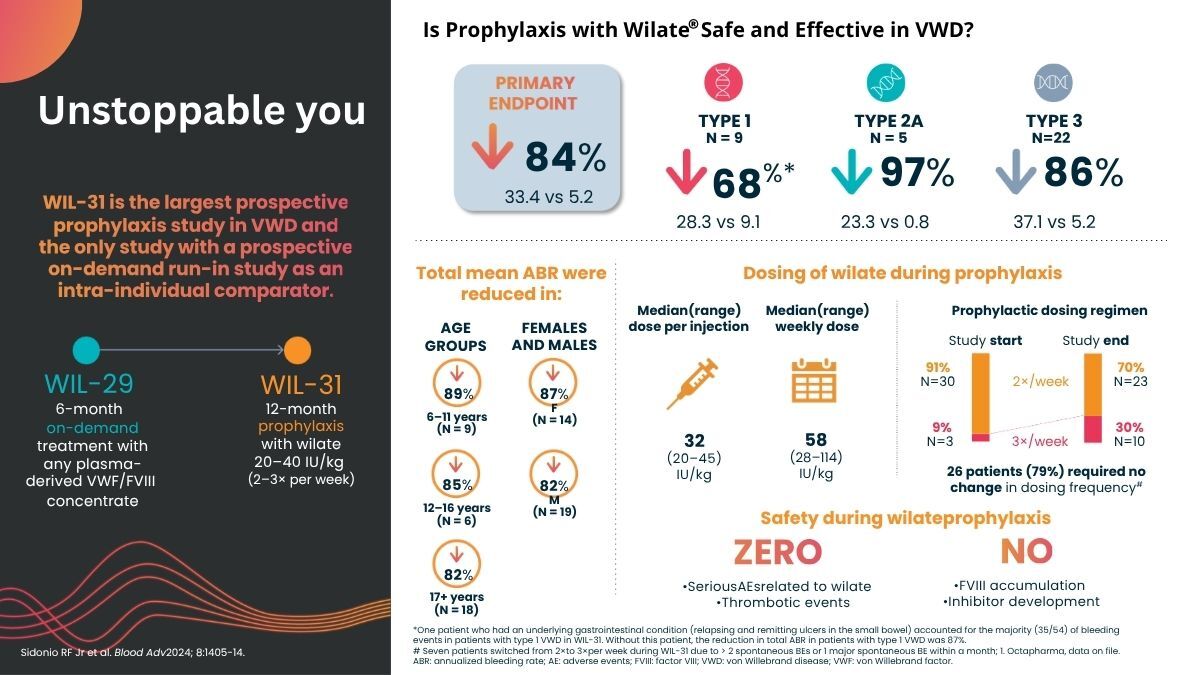
## Is Prophylaxis with Wilate® Safe and Effective in VWD?
Sidonio RF Jr et al. — *Blood Advances*
2024 · 8:1405–14
What this means for practice
Prophylaxis with wilate reduced mean total annualised bleed rate by 84% versus on-demand treatment. Results were consistent across all VWD types, age groups, genders and bleed types. No serious adverse events, no thrombotic events, no FVIII accumulation or inhibitor development over 12 months. The evidence base for proactive management of VWD is established. Where care remains reactive, the gap is in practice — not in data.
[Read the manuscript →](https://ashpublications.org/bloodadvances/article/8/6/1405/514639/von-Willebrand-factor-factor-VIII-concentrate)
84%
Reduction in mean total ABR — primary endpoint
97%
ABR reduction in Type 2A patients (23.3 vs 0.8)
86%
ABR reduction in Type 3 patients (37.1 vs 5.2)
Zero
Serious AEs, thrombotic events, or inhibitor development
[](https://hubs.ly/Q04f9w720)
From WIL-31
## Six sub-analyses from WIL-31. Each addresses a distinct clinical question across the VWD patient journey.
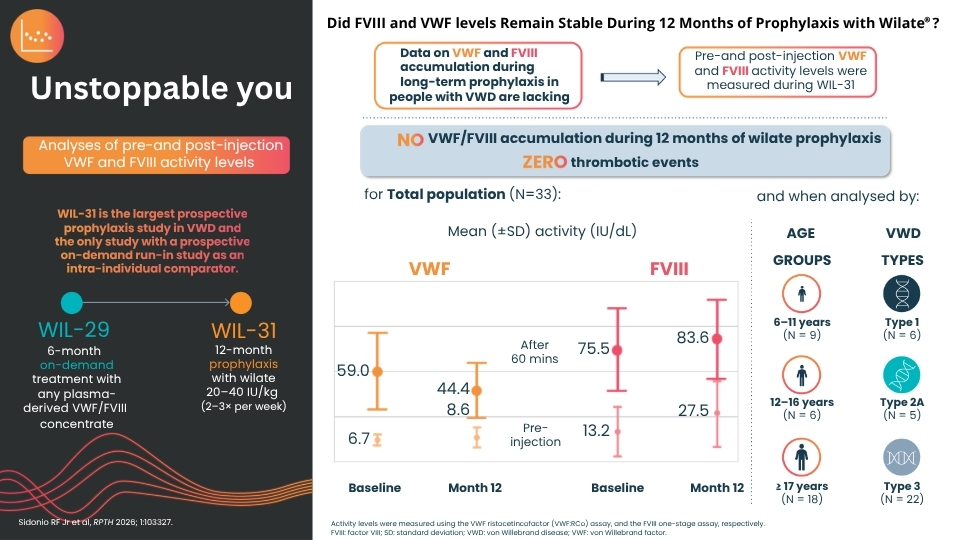
### Did FVIII and VWF levels Remain Stable During 12 Months of Prophylaxis with Wilate®?
Robert F. Sidonio Jr, Ana Boban, Claudia Djambas Khayat, on behalf of the WIL-31 Study Investigators
2026 · Research and Practice in Thrombosis and Haemostasis
Long-term safety data in VWD prophylaxis has been lacking. This study provides it. No VWF or FVIII accumulation observed over 12 months. Zero thrombotic events. Findings consistent across all age groups and VWD types.
[Read manuscript →](https://www.rpthjournal.org/article/S2475-0379(25)00651-X/fulltext)
[](https://hubs.ly/Q04f9wvd0)
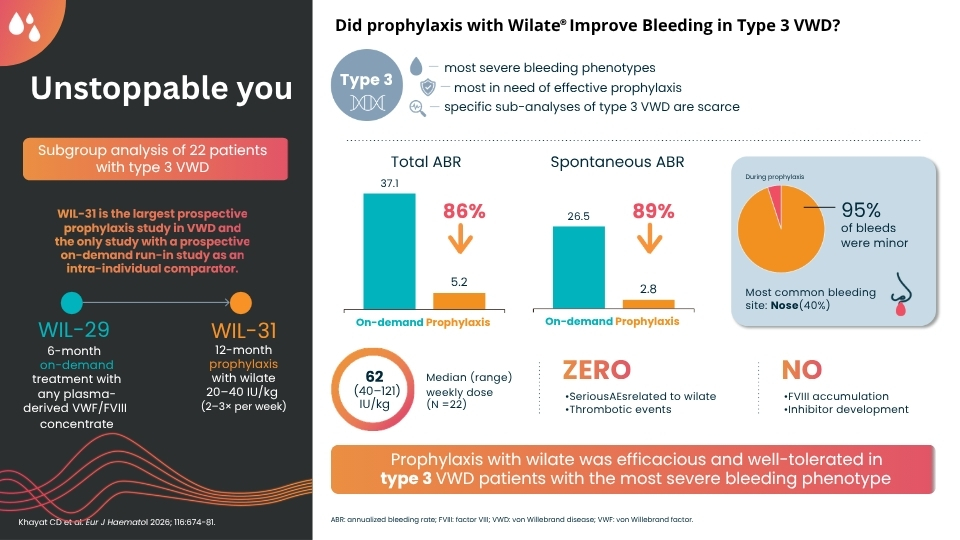
### Did prophylaxis with Wilate® Improve Bleeding in Type 3 VWD?
Claudia Djambas Khayat, Leonid Dubey, Adlette Inati, Toshko Lissitchkov, Dzmitry Novik, Elina Peteva, Robert F. Sidonio Jr, Ali T. Taher, Kateryna V. Vilchevska, Vladimir Vdovin, Ana Boban
2026 · European Journal of Haematology
86% reduction in annualised bleed rate in Type 3 patients — the most severe form of VWD. Zero serious treatment-related adverse events. The case for prophylaxis in Type 3 is documented. The gap is in its adoption.
[Read manuscript →](https://onlinelibrary.wiley.com/doi/10.1111/ejh.70117)
[](https://hubs.ly/Q04f9x360)
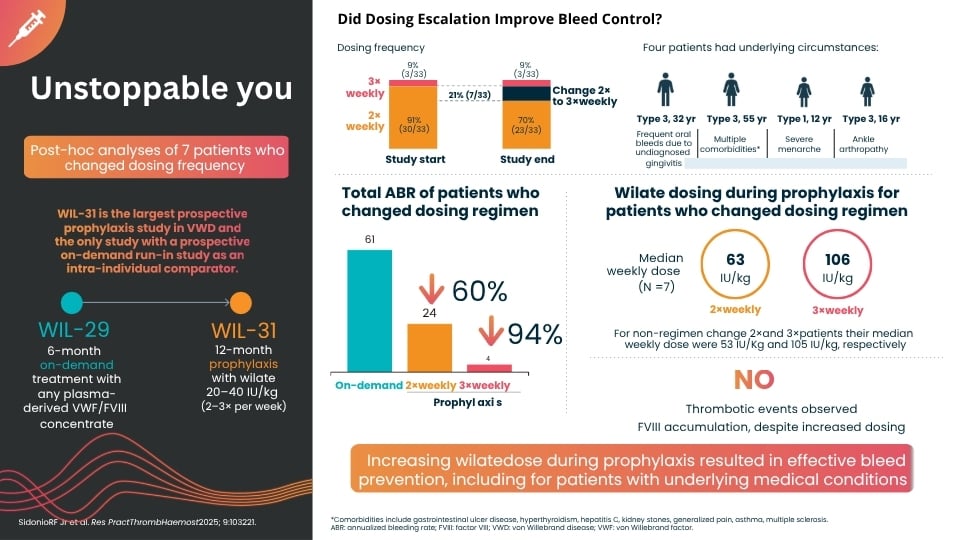
### Did Dosing Escalation Improve Bleed Control?
Robert F. Sidonio Jr, Ana Boban, Toshko Lissitchkov, Laszlo Nemes, Vladimir Vdovin, Claudia Djambas Khayat
2025 · Research and Practice in Thrombosis and Haemostasis
Dosing flexibility is not a barrier to consistent practice. 79% of patients required no change in dosing frequency. In the 21% who did, increasing to 3x weekly achieved effective bleed prevention — including in patients with underlying conditions.
[Read manuscript →](https://www.rpthjournal.org/article/S2475-0379(25)00545-X/fulltext)
[](https://hubs.ly/Q04f9w-c0)
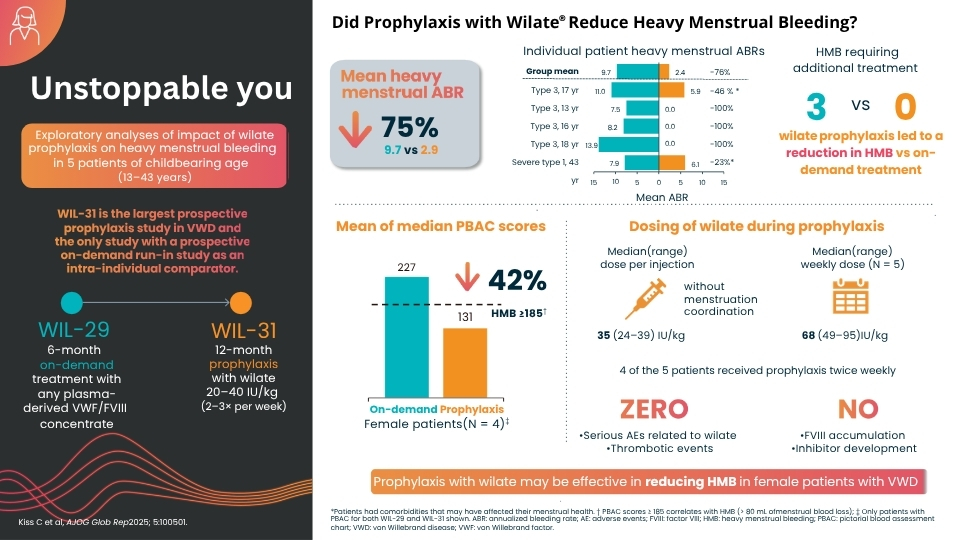
### Did Prophylaxis with Wilate® Reduce Heavy Menstrual Bleeding?
Csongor Kiss, Zoltan Boda, Claudia Djambas Khayat, Ana Boban, Leonid Dubey, Robert F. Sidonio Jr
2025 · Blood Coagulation and Fibrinolysis
Heavy menstrual bleeding in VWD is a measurable, treatable outcome. Protocols should reflect that. Mean heavy menstrual ABR reduced by 75%. PBAC scores fell 42%. Three of five patients reached zero HMB events.
[Read manuscript →](https://www.sciencedirect.com/science/article/pii/S2666577825000620?via%3Dihub)
[](https://hubs.ly/Q04f9w8s0)
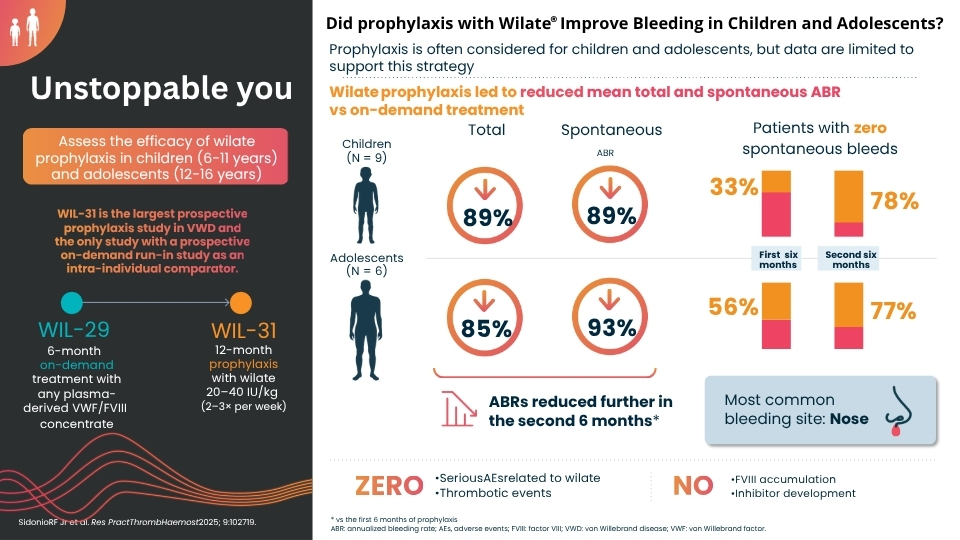
### Did prophylaxis with Wilate® Improve Bleeding in Children and Adolescents?
Robert F. Sidonio Jr, Leonid Dubey, Kateryna V. Vilchevska, Adlette Inati, Claudia Djambas Khayat
2025 · Research and Practice in Thrombosis and Haemostasis · Volume 9, Issue 2
Age-appropriate dosing data in VWD is limited. This analysis addresses that gap directly. Bleed rates reduced consistently across the 6–11 and 12–16 age groups. Wilate prophylaxis was effective and well tolerated in children and adolescents with VWD.
[Read manuscript →](https://www.rpthjournal.org/article/S2475-0379(25)00043-3/fulltext)
[](https://hubs.ly/Q04f9wJx0)
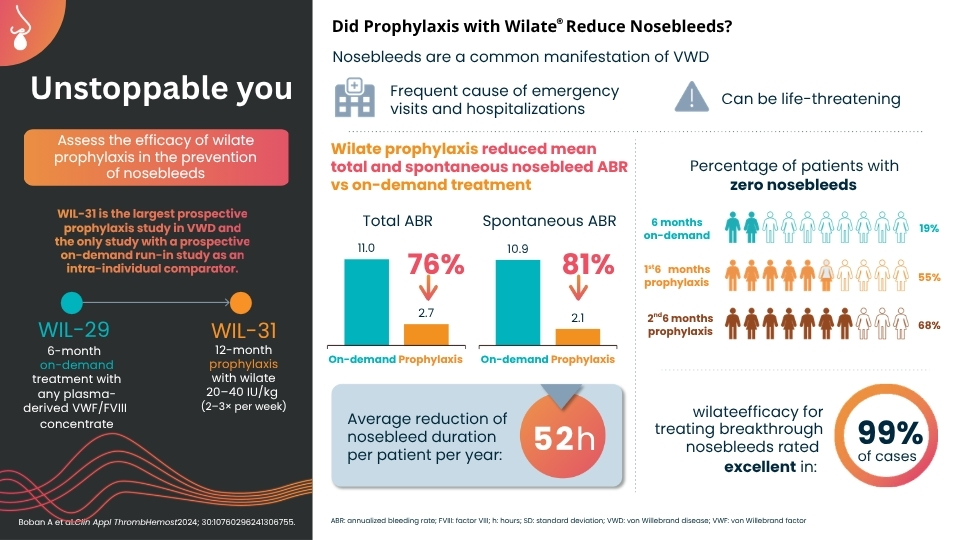
### Did Prophylaxis with Wilate® Reduce Nosebleeds?
Ana Boban, Leonid Dubey, Robert F. Sidonio Jr et al.
2025 · Clinical and Applied Thrombosis/Hemostasis
Nosebleeds are among the most frequent and disruptive manifestations of VWD. Mean total and spontaneous nosebleed ABRs reduced by 76% and 81% respectively. In the second 6 months of prophylaxis, reductions deepened further. The efficacy of wilate in breakthrough nosebleeds was rated excellent in 99% of cases.
[Read manuscript →](https://journals.sagepub.com/doi/10.1177/10760296241306755)
[](https://hubs.ly/Q04f9w7p0)
Did FVIII and VWF levels Remain Stable During 12 Months of Prophylaxis with Wilate®?
▼
[](https://hubs.ly/Q04f9w8s0)
Long-term safety data in VWD prophylaxis has been lacking. This study provides it. No VWF or FVIII accumulation over 12 months. Zero thrombotic events. Findings consistent across all age groups and VWD types.
2026 · Research and Practice in Thrombosis and Haemostasis
[Read manuscript →](https://www.rpthjournal.org/article/S2475-0379(25)00651-X/fulltext)
Did prophylaxis with Wilate® Improve Bleeding in Type 3 VWD?
▼
[](https://hubs.ly/Q04f9x360)
86% reduction in annualised bleed rate in Type 3 patients. Zero serious treatment-related adverse events. The case for prophylaxis in Type 3 is documented. The gap is in its adoption.
2026 · European Journal of Haematology
[Read manuscript →](https://onlinelibrary.wiley.com/doi/10.1111/ejh.70117)
Did Dosing Escalation Improve Bleed Control?
▼
[](https://hubs.ly/Q04f9wJx0)
Dosing flexibility is not a barrier to consistent practice. 79% of patients required no change. In the 21% who did, increasing to 3x weekly achieved effective bleed prevention — including in patients with underlying conditions..
2025 · Research and Practice in Thrombosis and Haemostasis
[Read manuscript →](https://www.rpthjournal.org/article/S2475-0379(25)00545-X/fulltext)
Did Prophylaxis with Wilate® Reduce Heavy Menstrual Bleeding?
▼
[](https://hubs.ly/Q04f9w8s0)
Mean heavy menstrual ABR reduced by 75%. PBAC scores fell 42%. Three of five patients reached zero HMB events. Heavy menstrual bleeding in VWD is a measurable, treatable outcome.
2025 · Blood Coagulation and Fibrinolysis
[Read manuscript →](https://www.sciencedirect.com/science/article/pii/S2666577825000620?via%3Dihub)
Did prophylaxis with Wilate® Improve Bleeding in Children and Adolescents?
▼
[](https://hubs.ly/Q04f9wJx0)
Bleed rates reduced consistently across the 6–11 and 12–16 age groups. Wilate prophylaxis was effective and well tolerated in children and adolescents with VWD.
February 2025 · Research and Practice in Thrombosis and Haemostasis · Volume 9, Issue 2
[Read manuscript →](https://www.rpthjournal.org/article/S2475-0379(25)00043-3/fulltext)
Did Prophylaxis with Wilate® Reduce Nosebleeds?
▼
[](https://hubs.ly/Q04f9w7p0)
Mean total and spontaneous nosebleed ABRs reduced by 76% and 81% respectively. The efficacy of wilate in breakthrough nosebleeds was rated excellent in 99% of cases.
2025 · Clinical and Applied Thrombosis/Hemostasis
[Read manuscript →](https://journals.sagepub.com/doi/10.1177/10760296241306755)
Live from Åland Island · Sept 22–25, 2026
# 100 years later: back to *where it all began.*
Four Canadian clinicians travel back to the islands where von Willebrand disease was first described. Follow their one-week journey for exclusive updates, learnings, and insights.
Enter the live feed
The 2026 cohort
## Introducing the 2026 Åland Island cohort
First held in 1998 and co-chaired by Erik Berntorp and Riitta Lassila, the Åland Island international knowledge exchange program brings together leading clinicians, scientists, and experts dedicated to advancing the understanding and management of VWD. With representation across various corners of the world, the program provides one week of focused learning and the exchange of new perspectives. Drawing participants from around the world, the program offers a week of focused learning and a genuine exchange of perspectives.
From September 22nd – 25th 2026, they joined 50+ colleagues from across 15+ countries in Helsinki, Mariehamn and Föglö.
AH
Dr. Amye Harrigan
QEII Health Sciences, Halifax
CM
Dr. Caroline Malcolmson
The Hospital for Sick Children, Toronto
CP
Dr. Chai Phua
London Health Sciences, London
DG
Dr. Dawn Goodyear
Foothills Medical Centre, Calgary
### Have a question for the Canadian Cohort?
Send a question
The feed
## Follow the week, day by day.
The story
## Why Åland?
In February 1926, a physician in Helsinki published a paper about a family from a small island in the Åland archipelago. Their children bled, daughters as often as sons, in a way classic hemophilia could not explain. He called it hereditary pseudohemophilia. Today, we call it von Willebrand disease.
Since his early observations, remarkable progress has been made in the diagnosis, classification, and management of VWD. Advances in laboratory testing, genetic analysis, clinical care, and therapeutic options have significantly improved outcomes for many patients.
However, important challenges remain. Delays in diagnosis persist and substantial variations in access to treatment continue to exist across different patient communities and Canadian hemophilia treatment centres.
One hundred years later, that is exactly why four Canadian clinicians are travelling back to those islands.

Dr. Erik Berntorp, Åland Island 2024
On the table
## Seven questions, from diagnosis to treatment.
Is VWD care where it should be today? How are patients doing? What does severe VWD truly mean? How can diagnosis be improved? What does multidisciplinary treatment for women with VWD look like? How can preventative treatment be personalized? Why does von Willebrand Factor matter?
It didn't end there.
These learnings were brought back to Canadian hemophilia treatment centres to continue the exchange of scientific evidence and new perspectives.
[Read the summary of the 2024 Åland Island Meeting →](https://onlinelibrary.wiley.com/doi/10.1111/hae.70302)
Take it further
## How do you want to continue the conversation?
### Send a question to the cohort
Ask a question →
### Talk to Medical Affairs
[Get in touch →](mailto:vwd.canada@octapharma.com?subject=Regarding%20Aland%20Island%202026)
### Nominate yourself or your centre for a knowledge exchange session, locally or nationally. First come, first served.
Nominate now →
×
Ask the cohort
This information is only intended for healthcare professionals practising in Canada.
×
Join the Rethink VWD Network
Share your interests and we will get in touch with you.
This initiative is made possible through an unrestricted educational grant from Octapharma Canada Inc., a global leader in the research and development of treatments for rare, inherited bleeding disorders.
© Octapharma Canada 2026 [Privacy Policy](https://www.octapharma.ca/en/octapharma/privacy-statement) [Terms of Use](https://www.octapharma.ca/en/octapharma/legal-statement) [events.canada@octapharma.com](mailto:events.canada@octapharma.com)
Cookie Settings